
Real Conversations Workplace Report 2026
Real Conversations Workplace Report 2026
Australia has learned to listen. It hasn't learned to understand.
The State of Connection in Corporate Australia.
A national study of connection in Australian workplaces, asked from both sides of the same conversation.
Australia knows how many of its workers are struggling. It knows how psychosocially safe their workplaces are, and a great deal about whether people feel able to speak up. So far as we can find, it has never had a national workplace measure of whether the conversation itself actually lands. That is what this report measures. This is year one.
Why do some conversations change everything, while others, held by good people who genuinely care, change nothing at all? Because not every conversation is created equal.
In the decade AI takes over the tasks, connection becomes the human capability that decides whether a workplace works. These pages measure how much of it corporate Australia has: what managers believe, what employees experience, and the distance between the two. Download the full report, or start with the findings below.
About this research. The findings on this page are from the Real Conversations Workplace Report 2026, a national study of two separate samples of Australians employed in private-sector organisations with 50 or more employees: 408 people managers with at least one direct report, and 306 employees with no direct reports who interact with their manager at least monthly. Wherever the two sides are compared, both answered on identical anchors; the employee confidence question carried one additional option, which is kept in the base throughout. The samples are independent: no manager in this study was rated by their own team. Fieldwork was conducted by Pureprofile, an ISO 20252 accredited research panel, between 21 August and 4 September 2026. Margins of error at the 95% confidence level are approximately ±4.9 percentage points for managers, ±5.6 for employees and ±7.1 on the Connection Gap. Results are unweighted. The Connection Gap is 68.6% minus 43.5%: 25.2 points, computed before rounding. The primary measure and the rule for calculating it were written down and dated before a single response was collected, and the full questionnaire and every calculation rule are printed in the report.
See full methodologyCite as: Wallis, M. (2026). Real Conversations Workplace Report 2026: The State of Connection in Corporate Australia. Mitch Wallis Consulting.
Research report by Mitch Wallis (Independent fieldwork by PureProfile)
Key findings
What is the state of connection in corporate Australia?
Nine in ten managers dealt with something personal or emotional in their team this year. This is what happened next, in order.
2026 baselineFinding 1
Connection means being understood, not fixed.
almost 4:1
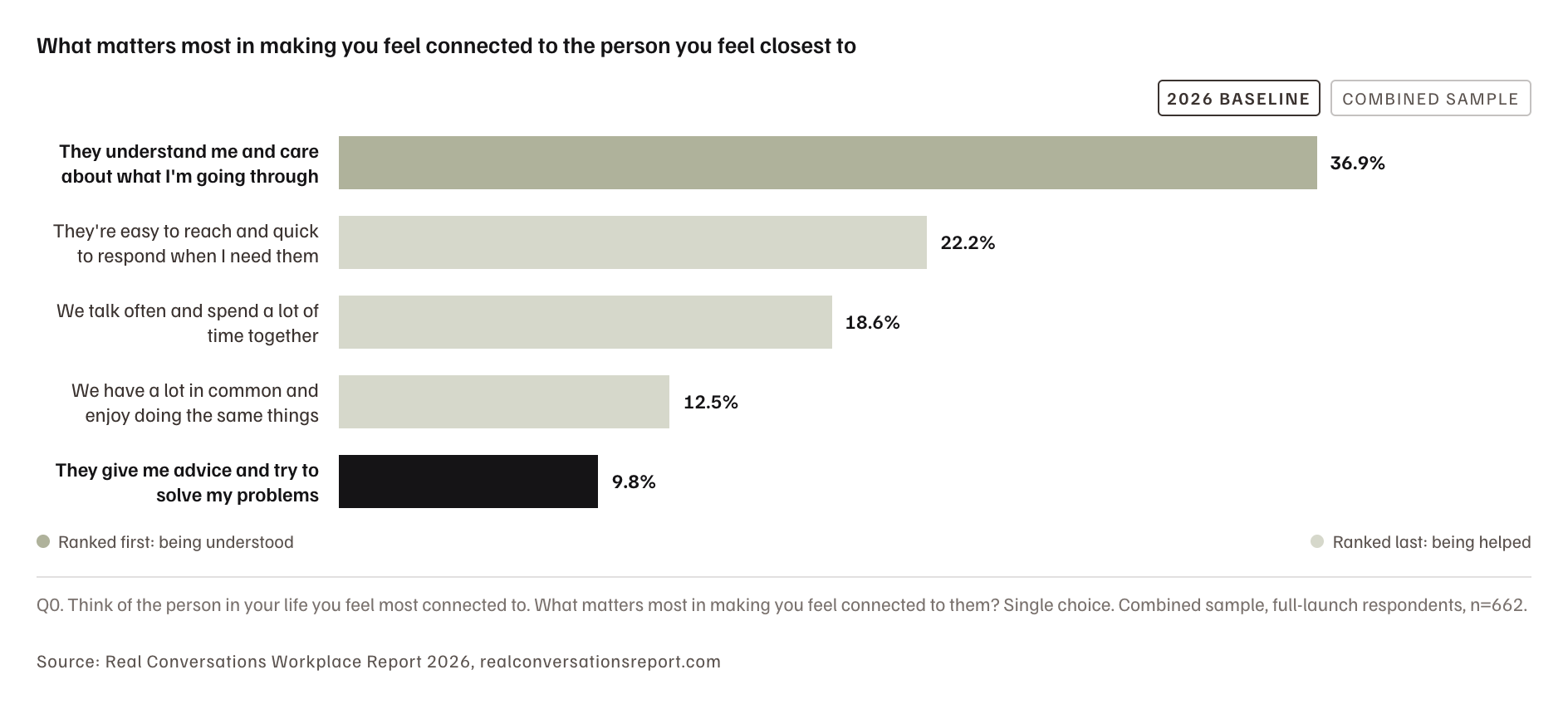
Australians say being understood, not being given advice and solutions, is what makes them feel connected (36.9% vs 9.8%).
What matters most in making you feel connected to the person you feel closest to
2026 baselineCombined sampleQ0. Think of the person in your life you feel most connected to. What matters most in making you feel connected to them? Single choice. Combined sample, full-launch respondents, n=662.
Finding 2
Managers overestimate their connection ability.
25 points
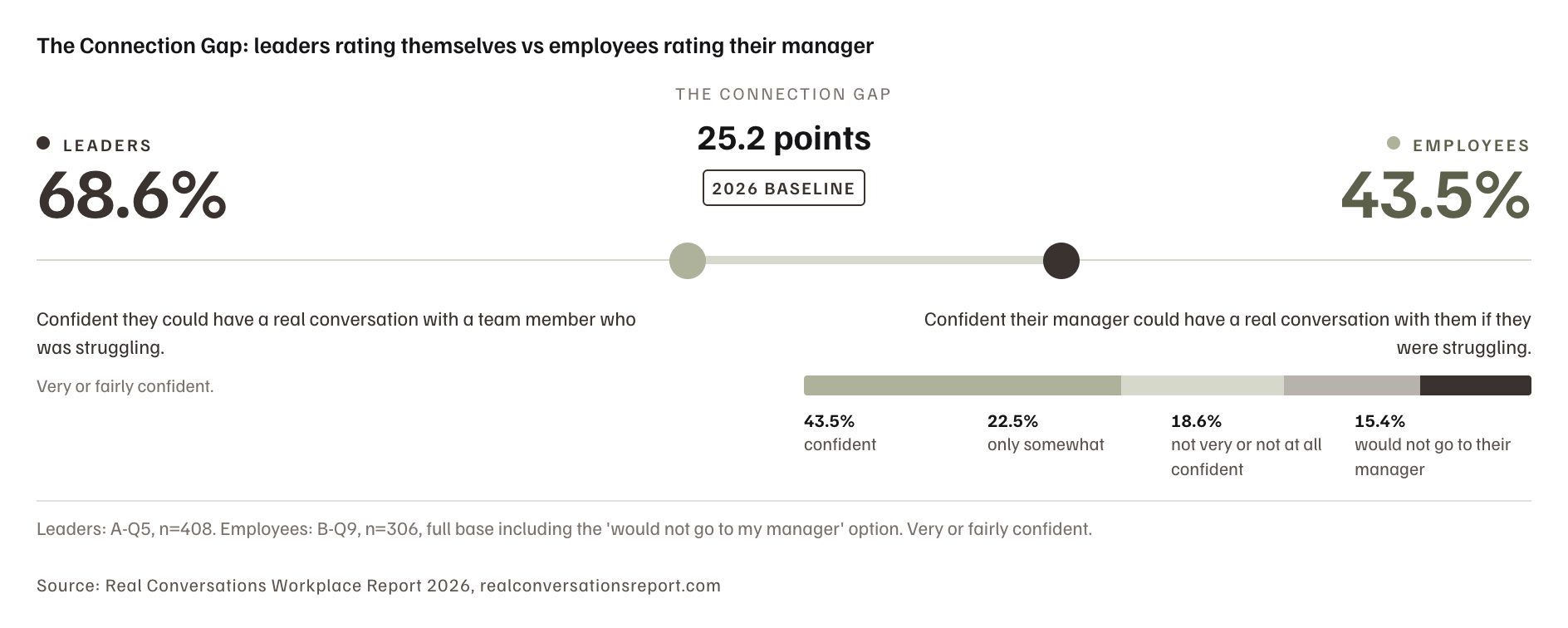
68.6% of managers are confident they could have a real conversation with a struggling team member. 43.5% of employees are confident their manager could. That 25-point distance is the Connection Gap.
The Connection Gap: leaders rating themselves vs employees rating their manager
Leaders
68.6%
The Connection Gap
25.2 points
2026 baselineEmployees
43.5%
Leaders: A-Q5, n=408. Employees: B-Q9, n=306, full base including the 'would not go to my manager' option. Very or fairly confident.
Finding 3
The conversation isn't landing.
65% vs 42%
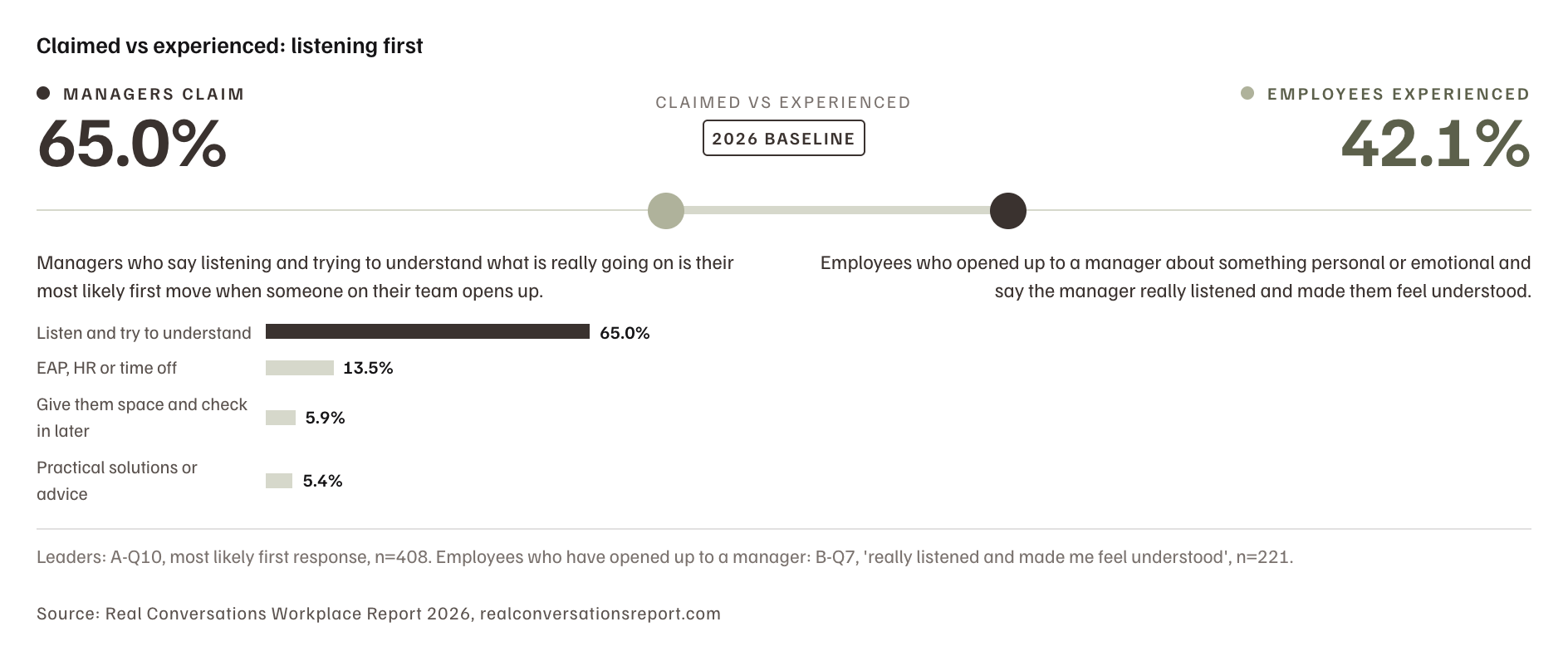
Managers who say listening is their first move, against employees who opened up and felt really listened to.
Claimed vs experienced: listening first
Managers claim
65.0%
Claimed vs experienced
2026 baselineEmployees experienced
42.1%
Leaders: A-Q10, most likely first response, n=408. Employees who have opened up to a manager: B-Q7, 'really listened and made me feel understood', n=221.
Finding 4
So people go quiet.
69%
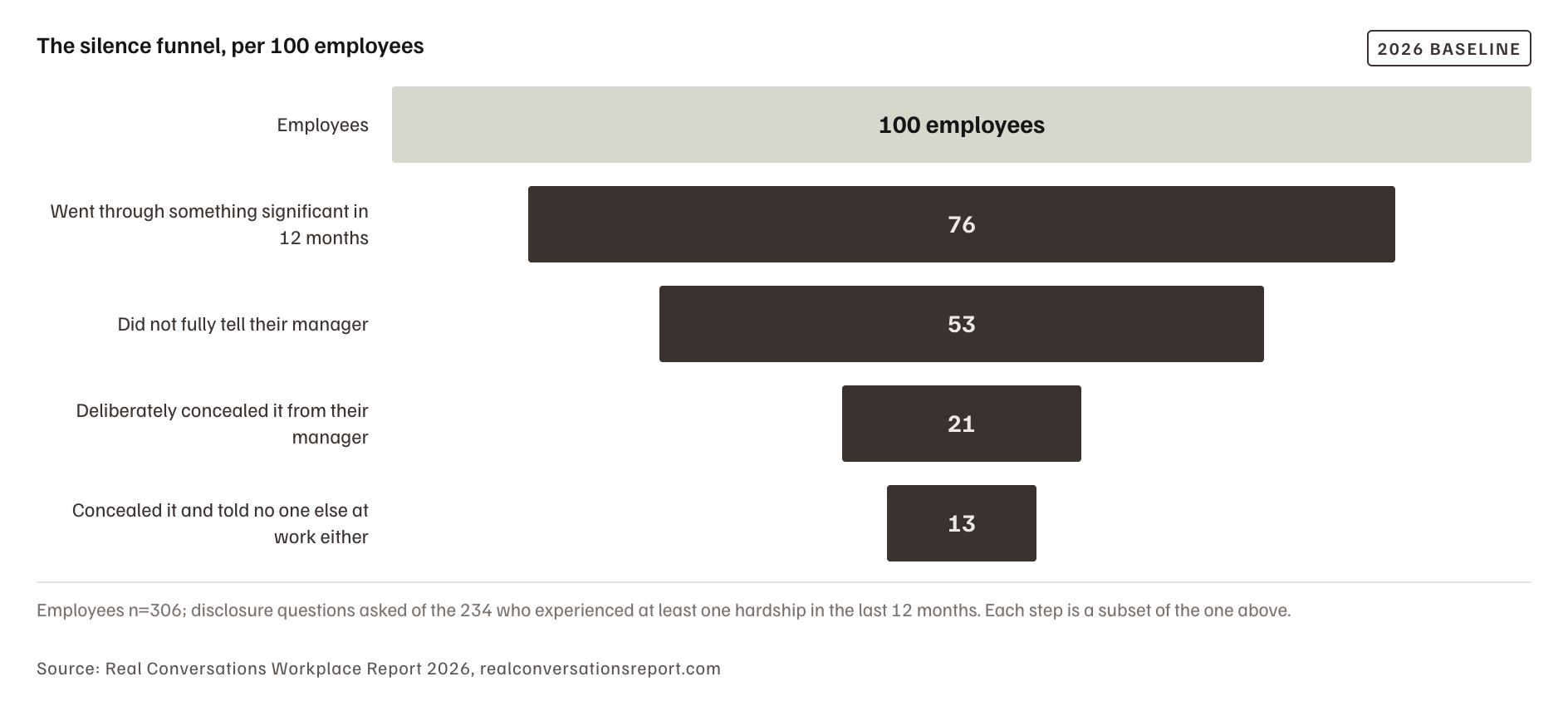
of employees who went through something significant in the last year never fully told their manager.
The silence funnel, per 100 employees
2026 baselineEmployees n=306; disclosure questions asked of the 234 who experienced at least one hardship in the last 12 months. Each step is a subset of the one above.
Finding 5
We still don't ask people if they're OK often enough.
44%
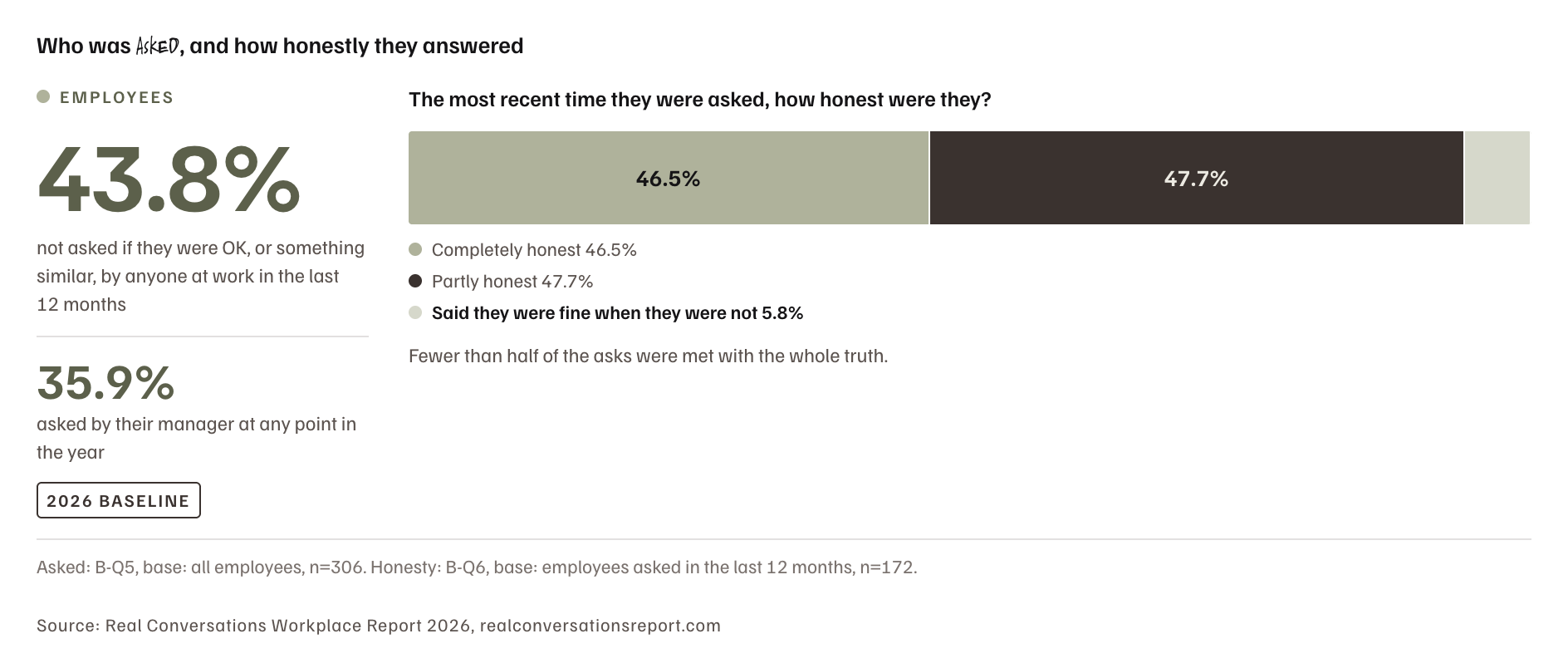
of employees were not asked if they were OK by anyone at work in a whole year. Of those who were asked, fewer than half (46.5%) answered completely honestly.
Who was asked, and how honestly they answered
Employees
43.8%
not asked if they were OK, or something similar, by anyone at work in the last 12 months
35.9%
asked by their manager at any point in the year
2026 baselineThe most recent time they were asked, how honest were they?
Fewer than half of the asks were met with the whole truth.
Asked: B-Q5, base: all employees, n=306. Honesty: B-Q6, base: employees asked in the last 12 months, n=172.
Finding 6
Silence has a steep price.
$3,600 to $4,900
per people manager, per year, in turnover and workers compensation costs attributed to conversations delayed, avoided or handled badly. This is the floor: lost productivity, disengagement and lost trust sit on top.
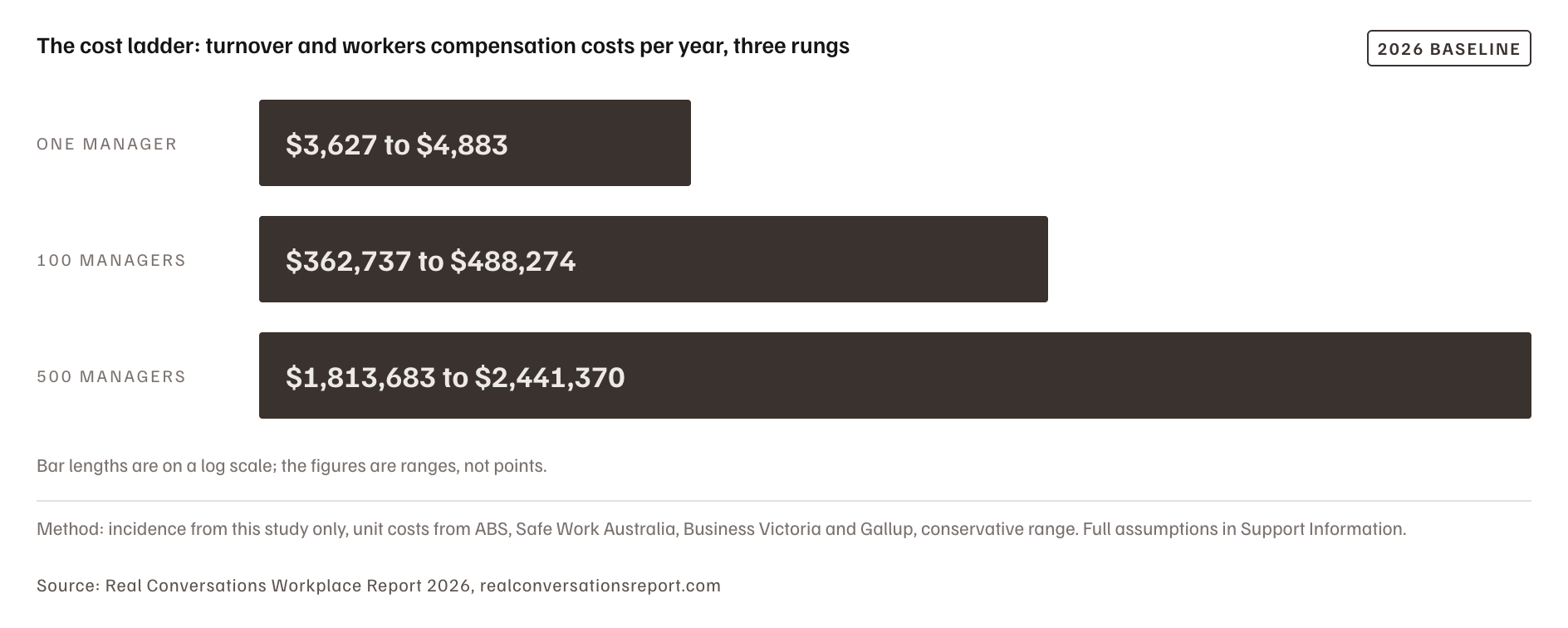
The cost ladder: turnover and workers compensation costs per year, three rungs
2026 baselineOne manager
100 managers
500 managers
Bar lengths are on a log scale; the figures are ranges, not points.
Method: incidence from this study only, unit costs from ABS, Safe Work Australia, Business Victoria and Gallup, conservative range. Full assumptions in Support Information.
Finding 7
The conversational load breaks at the coalface.
51%
First-line managers say their organisation has properly equipped them for these conversations. They are 61% of all managers, yet nearly 1 in 2 are not set up for success.
Senior executives against first-line managers, four measures
2026 baselineSenior leaders or executives n=65; first-line managers n=249. A-Q5, A-Q16b, A-Q18. Both series are people managers; the lighter marker here is first-line managers, not employees.
Finding 8
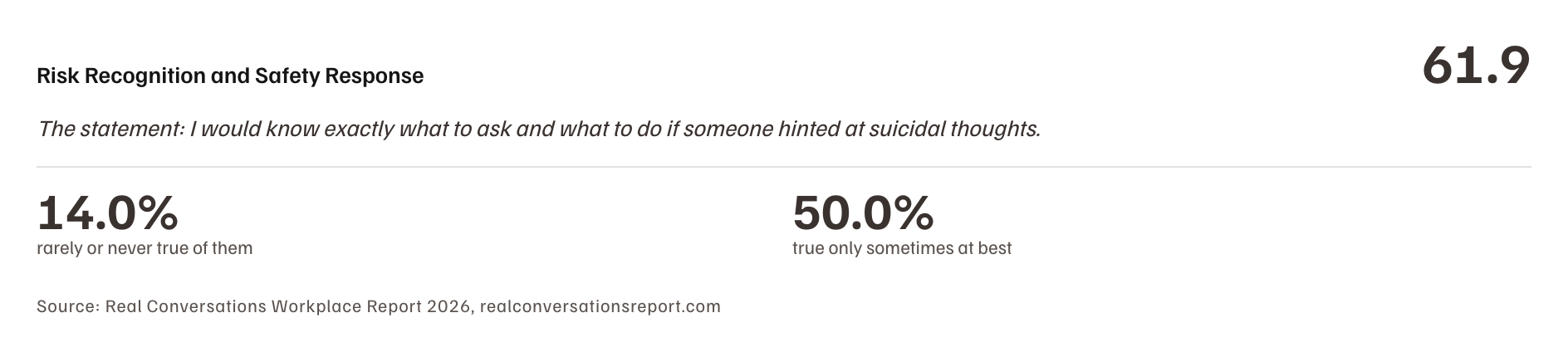
And the hardest conversation is the one fewest are ready for.
1 in 2
managers say that knowing exactly what to ask and what to do if someone hinted at suicidal thoughts is, at best, only sometimes true of them. 14.0% say rarely or never.
The twelve domains, ranked weakest to strongest
68.6
2026 baselineA-Q9, twelve behavioural statements, each mapped to one of the twelve domains of connection as a capability. Scored Always=100, Mostly=75, Sometimes=50, Rarely=25, Never=0. Base: people managers, n=408.
Corporate Australia's Real Conversations Capability Index
68.6 out of 100
2026 baselineAn index score out of 100 across twelve conversation behaviours, self-rated by 408 managers. Not a percentage.
If anything here raises something for you, Lifeline is available 24 hours a day on 13 11 14, and Beyond Blue on 1300 22 4636.
The thesis
Australia has learned to listen. It hasn't learned to understand.
What the eight findings add up to.
A decade ago this country decided to start asking, and the idea took. Asking became a national value, and the managers in this study have absorbed it. Almost two in three say listening is their first move, and there is no reason to doubt them.
But listening, as it is taught and as it is practised, is a posture. Stay calm. Give it time. Do not interrupt. Check in later. Every one of those is a decent instinct, and not one of them is the thing the person in front of you came for.
What Australians mean by connection is being understood. Not helped, not fixed, not referred. Understood. They say so by nearly four to one, and they say it about the person they are closest to in life, before this survey mentioned struggling at all.
Those are two different skills, and only one of them has ever been taught at scale. So the conversation looks right and lands wrong. The employee reads the room, decides the risk is not worth it, and edits the answer or says nothing at all. The manager, who did everything they were told to do, files it as a conversation that went fine.
Everything else in this report is built from this core insight. The silence. The disclosure that never happens. The cost that shows up two quarters later as a resignation nobody could explain. And the exposure that lands heaviest on first-line managers, the tier most employees report to and the one their organisations have equipped least.
None of this is a failure of empathy. It is a failure of training. Empathy is why managers ask. Skill is what happens next, and most managers were never taught it.
That is what the eight findings describe, and what the Real Conversations Capability Index now measures. This report is the case for teaching the second skill, and the instrument for checking whether we do.
The last decade made asking a value. The next one has to make understanding a skill.
Section 1
The eight findings
Finding 1 - What connection means
Australians want to be understood, not helped, by nearly four to one. Three in ten managers admit fixing is still their reflex.
almost 4:1
Being understood beat being helped by 3.7 to one (36.9% vs 9.8%).
Top takeaways
What matters most in making you feel connected to the person you feel closest to
Q0. Think of the person in your life you feel most connected to. What matters most in making you feel connected to them? Single choice. Combined sample, full-launch respondents, n=662.
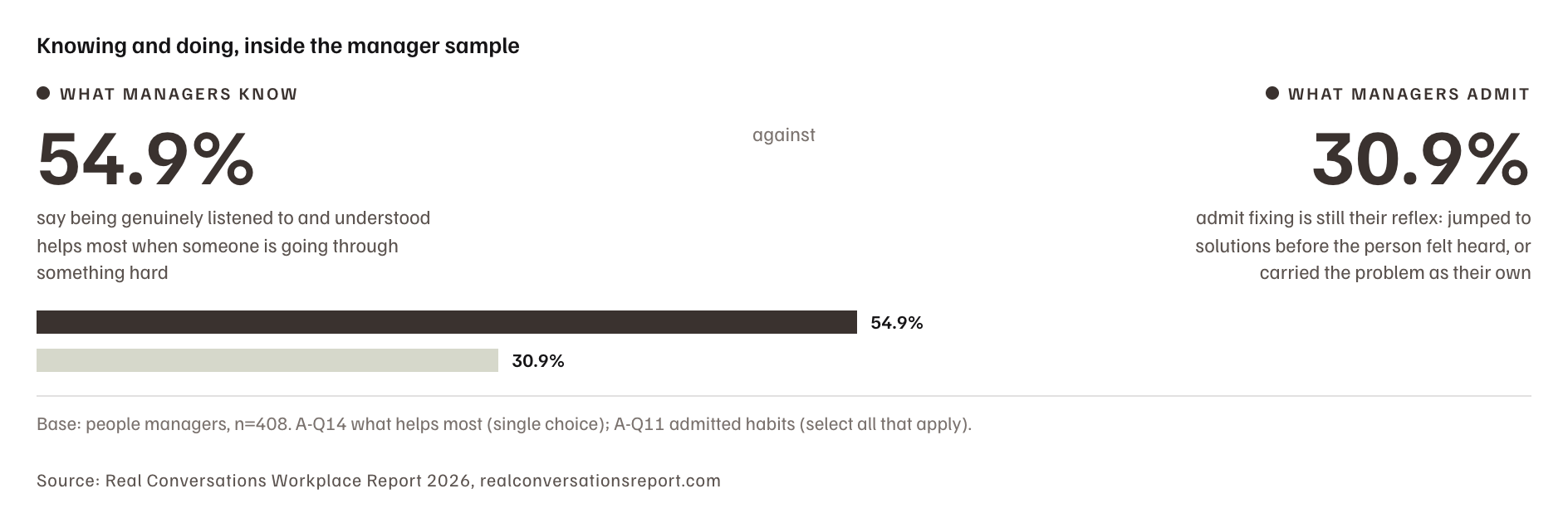
Knowing and doing, inside the manager sample
What managers know
54.9%
say being genuinely listened to and understood helps most when someone is going through something hard
What managers admit
30.9%
admit fixing is still their reflex: jumped to solutions before the person felt heard, or carried the problem as their own
Base: people managers, n=408. A-Q14 what helps most (single choice); A-Q11 admitted habits (select all that apply).
“Don't need to solve the problem, just understand and give space and time.”
What this means
For people and L&D leaders. Every program that teaches managers what to say is competing with a reflex 30.9% of them admit to. Teach the reflex, not the script.
Finding 2 - The Connection Gap
Managers rate their ability to have a real conversation 25 points higher than employees rate their own managers. That confidence is part of what keeps the gap open.
The Connection Gap: leaders rating themselves vs employees rating their manager
Leaders
68.6%
The Connection Gap
25.2 points
2026 baselineEmployees
43.5%
Confident they could have a real conversation with a team member who was struggling.
Very or fairly confident.
Confident their manager could have a real conversation with them if they were struggling.
confident22.5%
only somewhat18.6%
not very or not at all confident15.4%
would not go to their manager
Leaders: A-Q5, n=408. Employees: B-Q9, n=306, full base including the 'would not go to my manager' option. Very or fairly confident.
25 points
The Connection Gap: 25.2 points, computed before rounding.
Top takeaways
It survives every test we threw at it
17.3 pts
Excluding the 'would not go to my manager' respondents (employee confidence 51.4%)
< 1 pt
Movement when either sample is reweighted to the other on gender, age and organisation size
15+ pts
In every organisation size band and both genders
±7.1
Margin of error on the gap; the unlucky end of the range is still a gap of 18
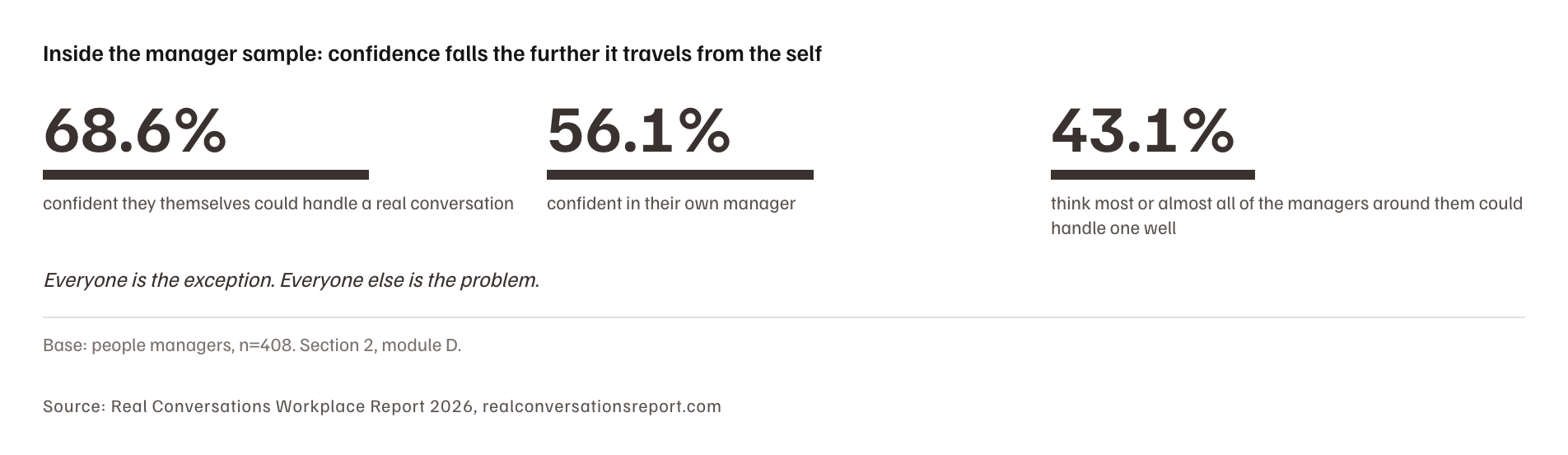
Inside the manager sample: confidence falls the further it travels from the self
68.6%
confident they themselves could handle a real conversation
56.1%
confident in their own manager
43.1%
think most or almost all of the managers around them could handle one well
Everyone is the exception. Everyone else is the problem.
Base: people managers, n=408. Section 2, module D.
“I think simply being more open and friendly, perhaps even less awkward, about personal matters would help. It feels like my manager has a 'work mode' where it feels very uncomfortable to even bring up personal matters. There is never really any initiation of conversation about my personal life.”
What this means
For people and L&D leaders. Self-assessed confidence is the wrong gate for training. 61.4% of confident managers have never been skills-trained, and confidence is not what tells you who needs it. Assess capability, not appetite.
Finding 3 - The listening illusion
Almost two in three managers say they listen first. Fewer than half of the employees who opened up felt understood. Australia has learned the script and never learned the skill.
65% vs 42%
65.0% of managers say listening is their first move. 42.1% of the employees who opened up felt really listened to and understood.
Top takeaways
Claimed vs experienced: listening first
Managers claim
65.0%
Claimed vs experienced
2026 baselineEmployees experienced
42.1%
Managers who say listening and trying to understand what is really going on is their most likely first move when someone on their team opens up.
Employees who opened up to a manager about something personal or emotional and say the manager really listened and made them feel understood.
Leaders: A-Q10, most likely first response, n=408. Employees who have opened up to a manager: B-Q7, 'really listened and made me feel understood', n=221.
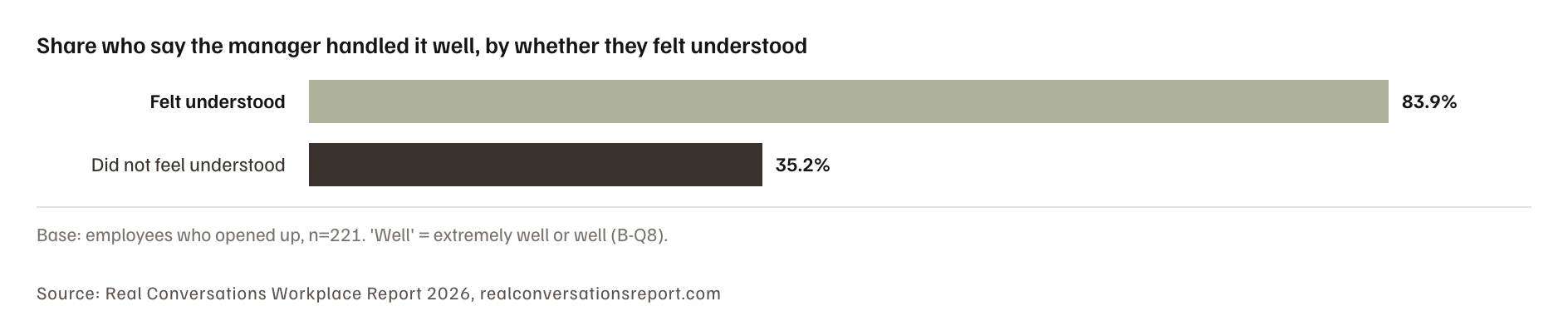
Listening is a posture. Being understood is a result.
Share who say the manager handled it well, by whether they felt understood
Base: employees who opened up, n=221. 'Well' = extremely well or well (B-Q8).
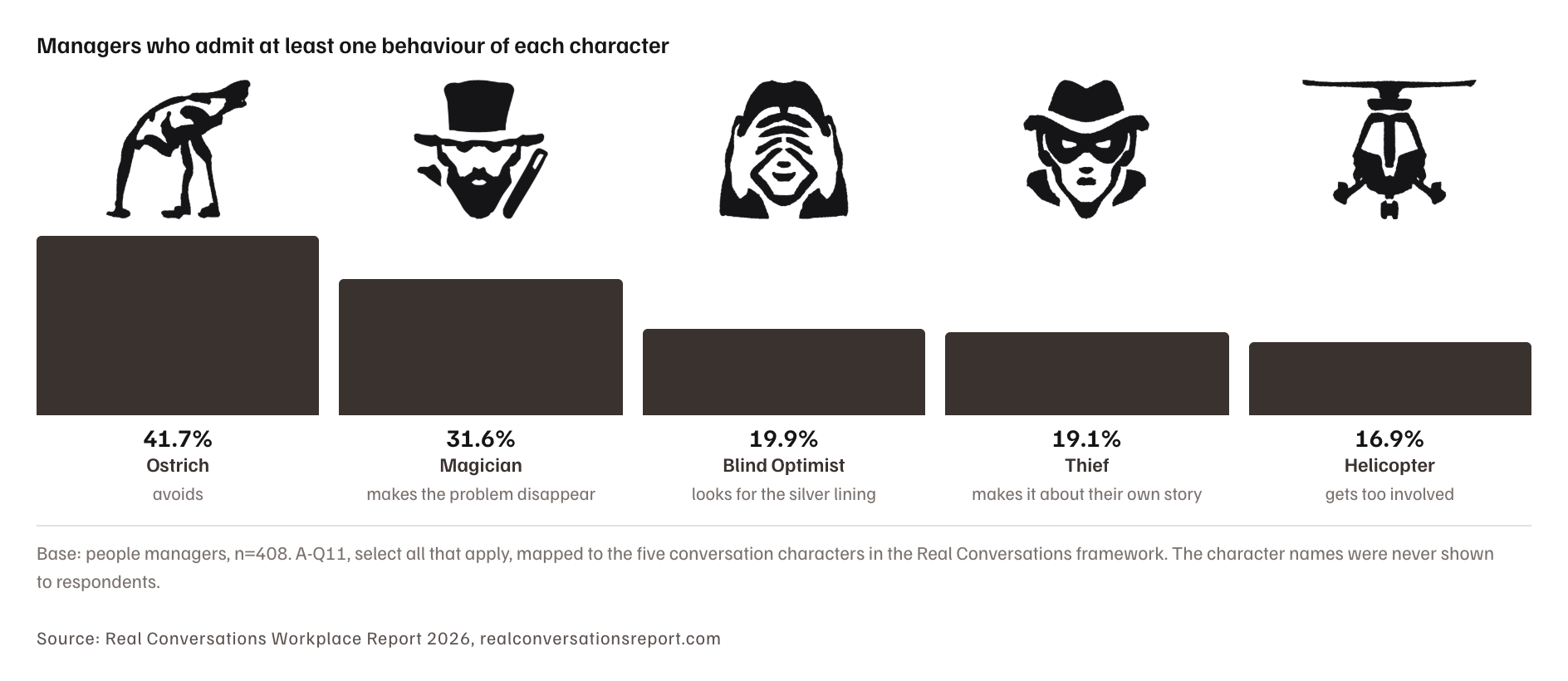
The managers know this about themselves, when you ask the right way. 79.9% admit at least one habit that shuts a conversation down.
Managers who admit at least one behaviour of each character

41.7%
Ostrich
avoids

31.6%
Magician
makes the problem disappear

19.9%
Blind Optimist
looks for the silver lining

19.1%
Thief
makes it about their own story

16.9%
Helicopter
gets too involved
Base: people managers, n=408. A-Q11, select all that apply, mapped to the five conversation characters in the Real Conversations framework. The character names were never shown to respondents.
“Just actually listening would help. They always compare it to how hard their life is, which might be valid, but they don't care about mine.”
What this means
For people and L&D leaders. Stop measuring whether managers know what to do. 65.0% say they do. Measure whether their people feel understood; it is the outcome that predicts whether the conversation is judged to have gone well.
Finding 4 - The Silence Tax
More than two-thirds of employees who went through something this year never fully told their manager. More than half of those who trusted their manager to handle it still didn't.
The silence funnel, per 100 employees
2026 baselineEmployees n=306; disclosure questions asked of the 234 who experienced at least one hardship in the last 12 months. Each step is a subset of the one above.
69%
68.8% of employees who went through something significant did not fully tell their manager: told them part of it 41.0%, deliberately kept it from them 27.8%. n=234.
Top takeaways
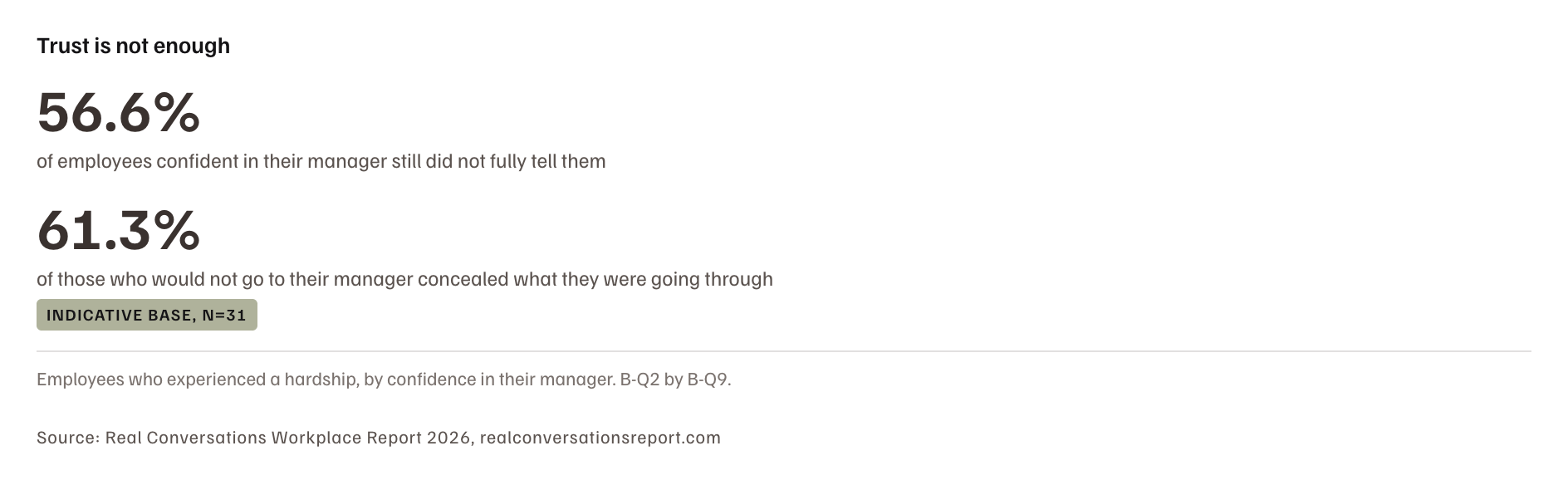
Trust is not enough
56.6%
of employees confident in their manager still did not fully tell them
61.3%
of those who would not go to their manager concealed what they were going through
Indicative base, n=31Employees who experienced a hardship, by confidence in their manager. B-Q2 by B-Q9.
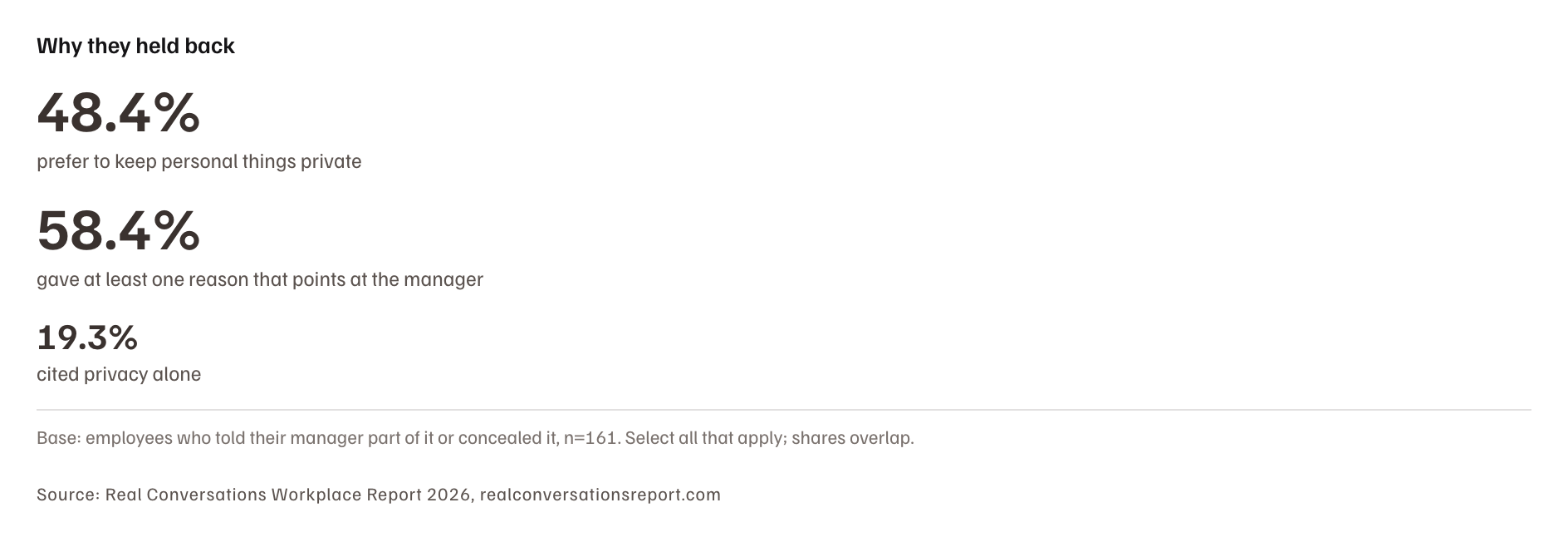
Why they held back
48.4%
prefer to keep personal things private
58.4%
gave at least one reason that points at the manager
19.3%
cited privacy alone
Base: employees who told their manager part of it or concealed it, n=161. Select all that apply; shares overlap.
“That it's not because I want to be unproductive and lazy, it's because something is genuinely getting to me and I am still trying.”
What this means
For executives. Your engagement survey and your EAP utilisation data are both measuring the people who speak. This finding is about the 68.8% who don't tell the whole story. The absence of complaints is not the presence of health.
Finding 5 - The ask
Three in four Australians say it's important to ask if someone is OK. In a whole year, 44% of employees were never asked by anyone at work, and fewer than half of those who were asked answered completely honestly.
44%
43.8% of employees were not asked if they were OK, or something similar, by anyone at work in the last 12 months. All employees, n=306.
Top takeaways
Who was asked, and how honestly they answered
Employees
43.8%
not asked if they were OK, or something similar, by anyone at work in the last 12 months
35.9%
asked by their manager at any point in the year
The most recent time they were asked, how honest were they?
Fewer than half of the asks were met with the whole truth.
Asked: B-Q5, base: all employees, n=306. Honesty: B-Q6, base: employees asked in the last 12 months, n=172.
Employees asked in the last 12 months, n=172 (B-Q6). Managers, n=408 (A-Q16, agree or strongly agree).
R U OK? Day has done something remarkable to this country. Asking has become a national value. R U OK?'s own research reports that three in four Australians believe it is important to regularly ask someone if they are OK, and that nine in ten feel grateful, supported and cared for when someone does. This report has no quarrel with any of that. It measured what happens at work, after the ask, and what it found is a gap between the value and the behaviour.
“I wish they understood that even though I didn't want to discuss it, they could at least have checked in with me again at some point during my shift. I could have rung in sick but I didn't want to let the team down.”
What this means
For people and L&D leaders. The honesty gap is a capability gap wearing a wellbeing costume. People tell the truth to managers they believe can hold it. Train the holding, and the asking has a chance to work.
Finding 6 - What silence costs
Each people manager carries, on average, $3,600 to $4,900 a year in turnover and workers compensation costs attributed to conversations that were delayed, avoided or handled badly.
The cost ladder: turnover and workers compensation costs per year, three rungs
2026 baselineOne manager
100 managers
500 managers
Bar lengths are on a log scale; the figures are ranges, not points.
Method: incidence from this study only, unit costs from ABS, Safe Work Australia, Business Victoria and Gallup, conservative range. Full assumptions in Support Information.
$3,600 to $4,900
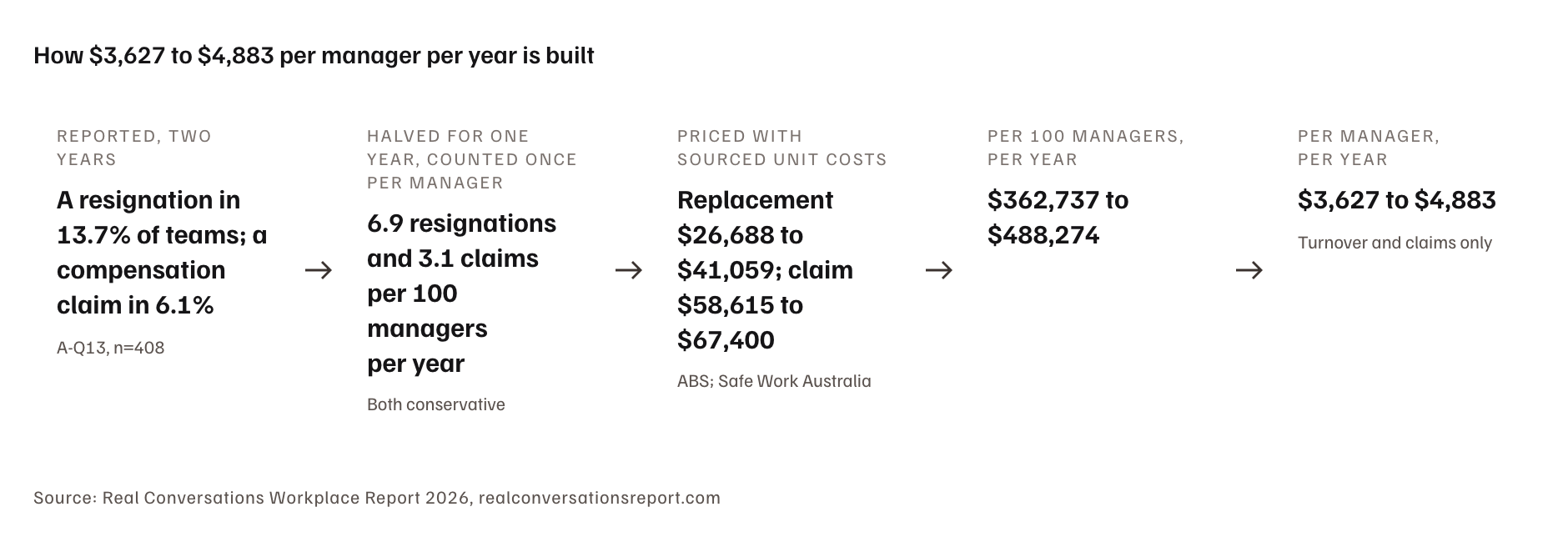
per people manager, per year, turnover and claims only. $3,627 to $4,883 exactly.
Top takeaways
How $3,627 to $4,883 per manager per year is built
Reported, two years
A resignation in 13.7% of teams; a compensation claim in 6.1%
A-Q13, n=408
Halved for one year, counted once per manager
6.9 resignations and 3.1 claims per 100 managers per year
Both conservative
Priced with sourced unit costs
Replacement $26,688 to $41,059; claim $58,615 to $67,400
ABS; Safe Work Australia
Per 100 managers, per year
$362,737 to $488,274
Per manager, per year
$3,627 to $4,883
Turnover and claims only
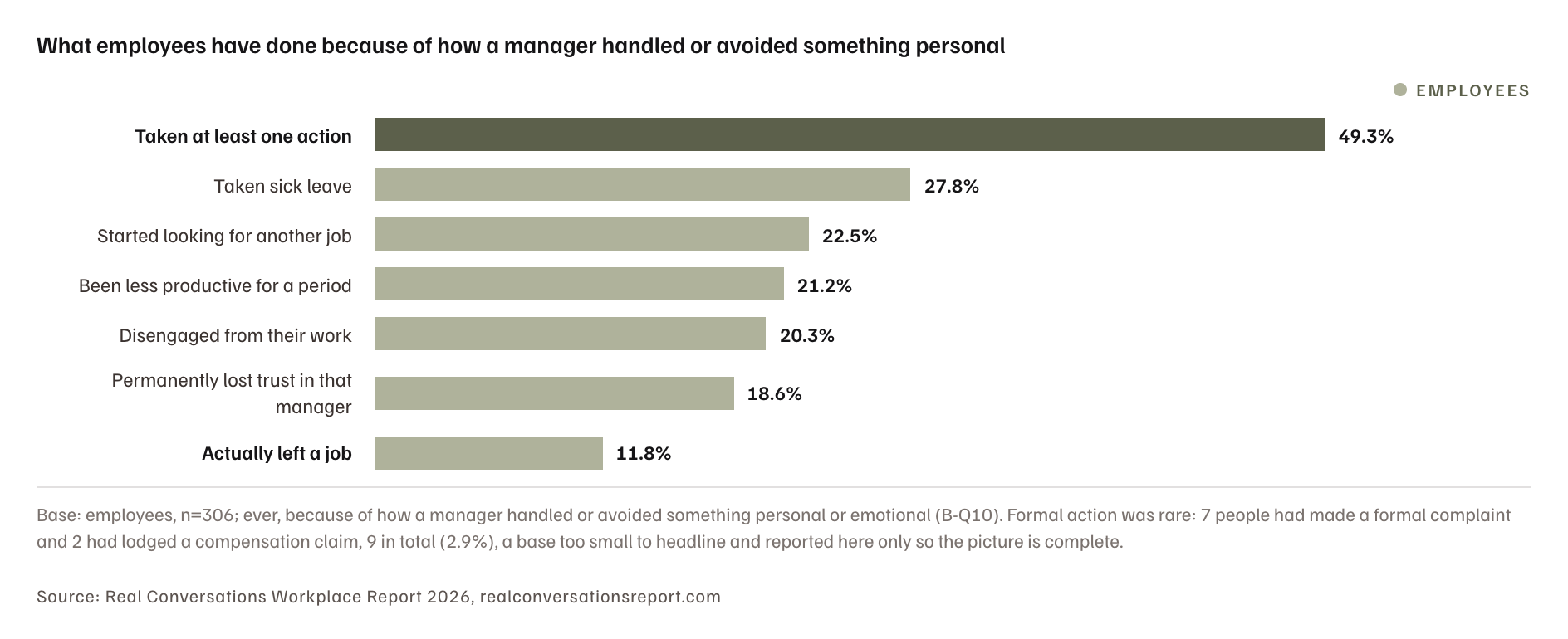
What employees have done because of how a manager handled or avoided something personal
Employees
Base: employees, n=306; ever, because of how a manager handled or avoided something personal or emotional (B-Q10). Formal action was rare: 7 people had made a formal complaint and 2 had lodged a compensation claim, 9 in total (2.9%), a base too small to headline and reported here only so the picture is complete.
“More empathy and understanding. Making staff feel heard and understood without judgement would raise retention rates and increase productivity and job satisfaction.”
What this means
For people and L&D leaders. This is the business case you have been asked for. It is conservative by construction, every input is sourced, and the method is published so finance can rebuild it. Use it to fund capability, not another awareness session.
The legal edge
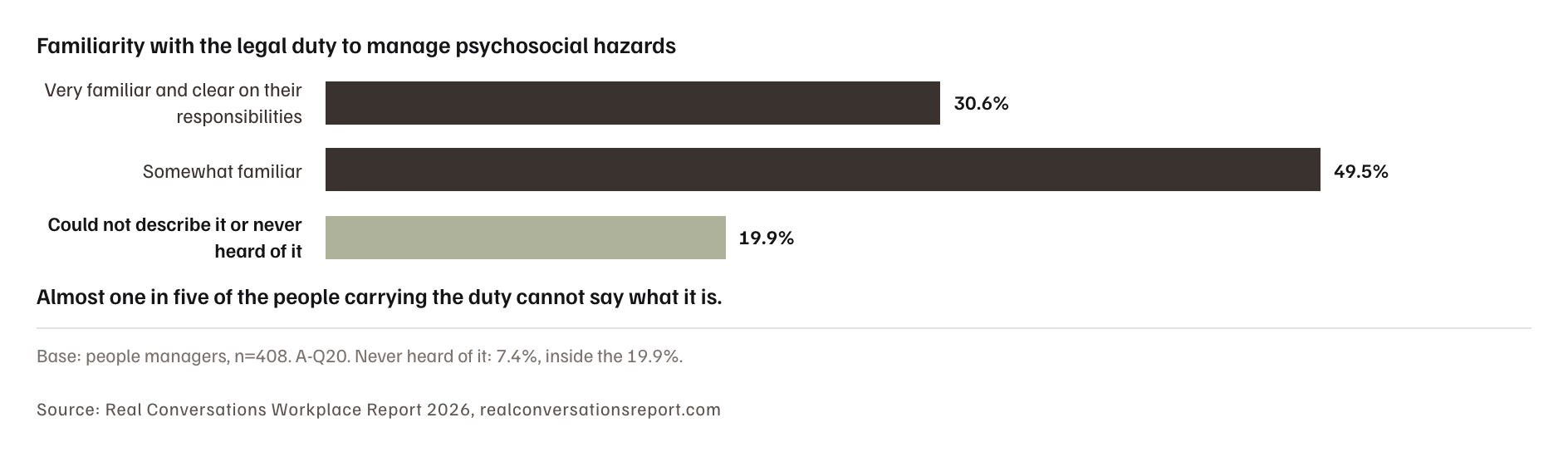
The duty almost one in five managers cannot describe
Familiarity with the legal duty to manage psychosocial hazards
Almost one in five of the people carrying the duty cannot say what it is.
Base: people managers, n=408. A-Q20. Never heard of it: 7.4%, inside the 19.9%.
Finding 7 - Where the gap lives
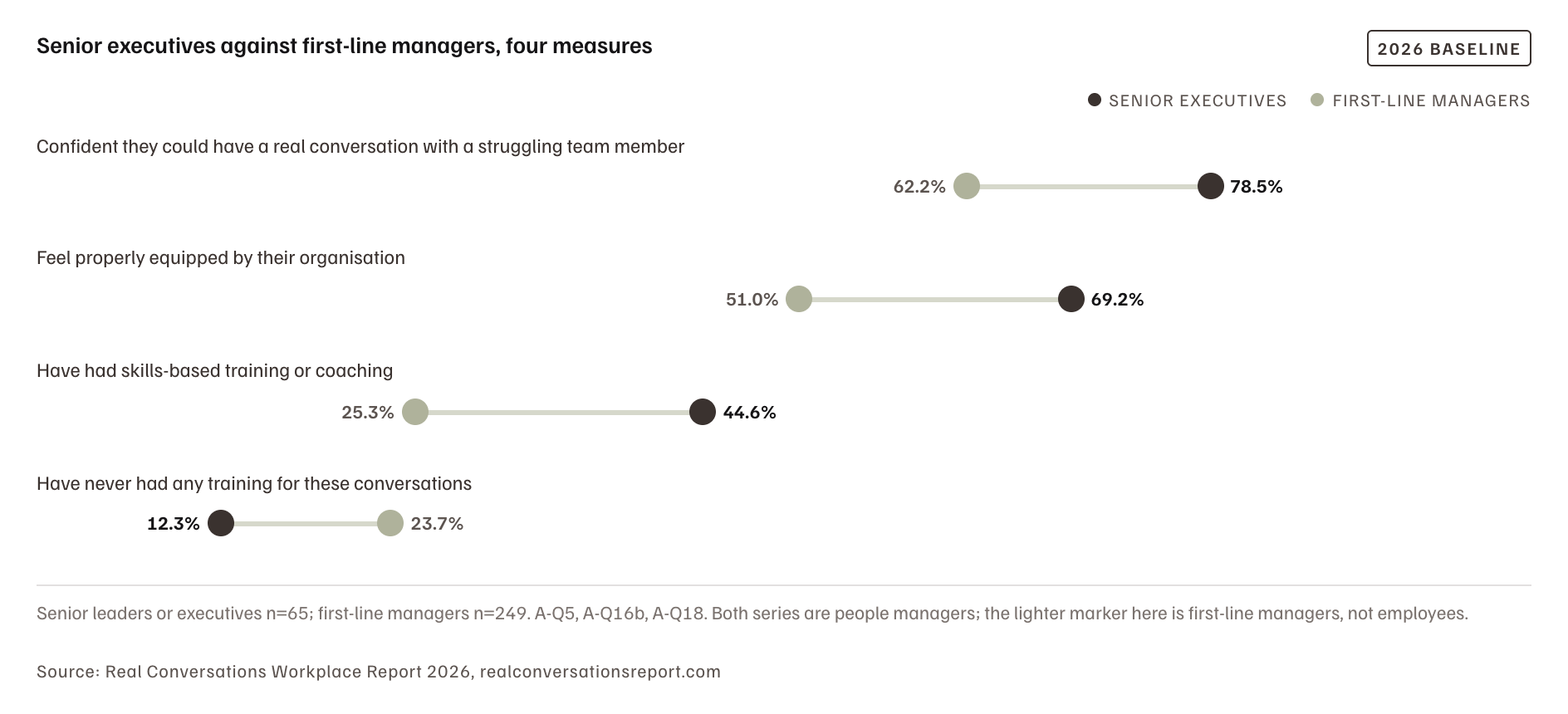
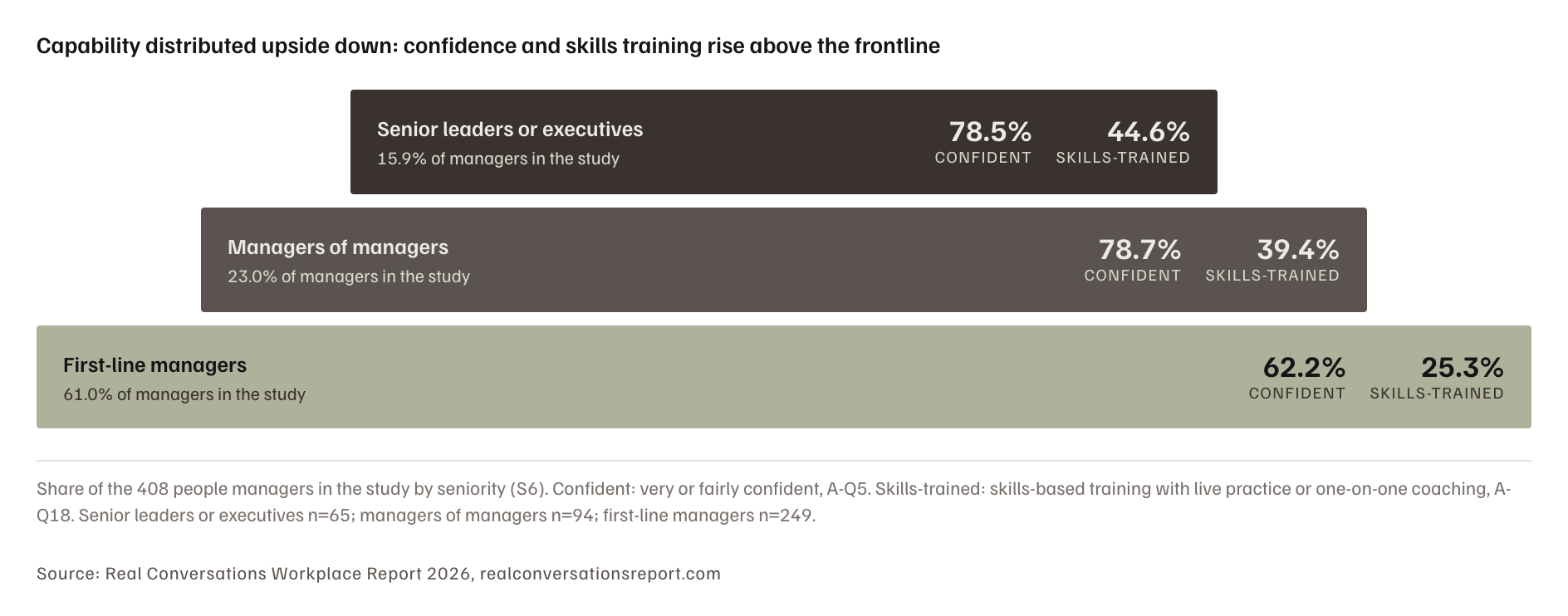
The conversations land on the layer least prepared to have them. First-line managers are the least confident, least trained and least equipped layer in the building, and the one most employees report to.
51%
51.0% of first-line managers feel properly equipped by their organisation for these conversations. First-line managers, n=249.
Top takeaways
Senior executives against first-line managers, four measures
2026 baselineSenior leaders or executives n=65; first-line managers n=249. A-Q5, A-Q16b, A-Q18. Both series are people managers; the lighter marker here is first-line managers, not employees.
Capability distributed upside down: confidence and skills training rise above the frontline
Senior leaders or executives
15.9% of managers in the study
78.5%
confident
44.6%
skills-trained
Managers of managers
23.0% of managers in the study
78.7%
confident
39.4%
skills-trained
First-line managers
61.0% of managers in the study
62.2%
confident
25.3%
skills-trained
Share of the 408 people managers in the study by seniority (S6). Confident: very or fairly confident, A-Q5. Skills-trained: skills-based training with live practice or one-on-one coaching, A-Q18. Senior leaders or executives n=65; managers of managers n=94; first-line managers n=249.
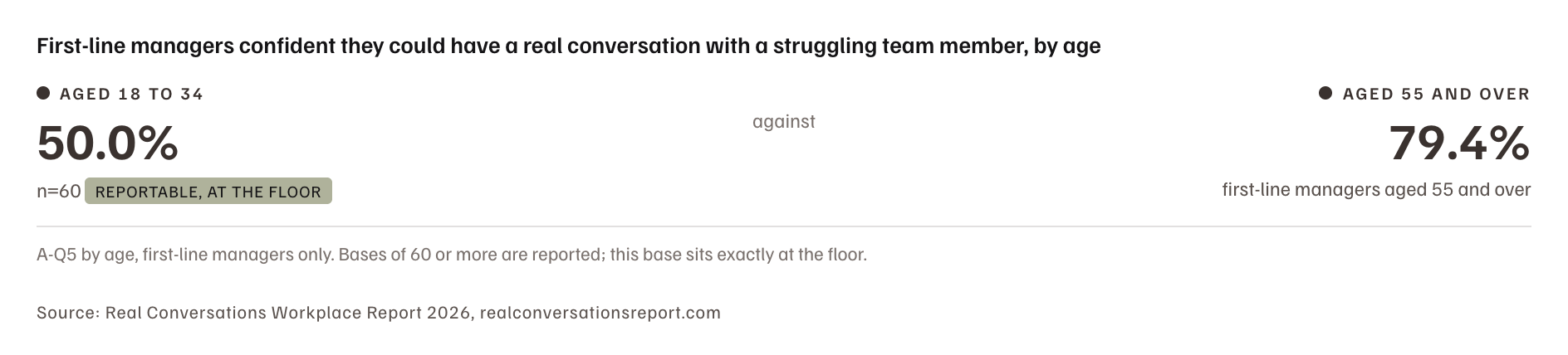
First-line managers confident they could have a real conversation with a struggling team member, by age
Aged 18 to 34
50.0%
n=60 Reportable, at the floor
Aged 55 and over
79.4%
first-line managers aged 55 and over
A-Q5 by age, first-line managers only. Bases of 60 or more are reported; this base sits exactly at the floor.
“Anything to do with disciplinary action. I like to stay positive and I'm not good at tough conversations.”
What this means
For executives. Your development spend is pointing at the wrong floor. Executives are 44.6% skills-trained; the first-line managers who, by headcount, receive most of the disclosures are 25.3%. Every dollar moved down the org chart reaches more of the people having these conversations than the dollar above it.
Finding 8 - The Real Conversations Capability Index
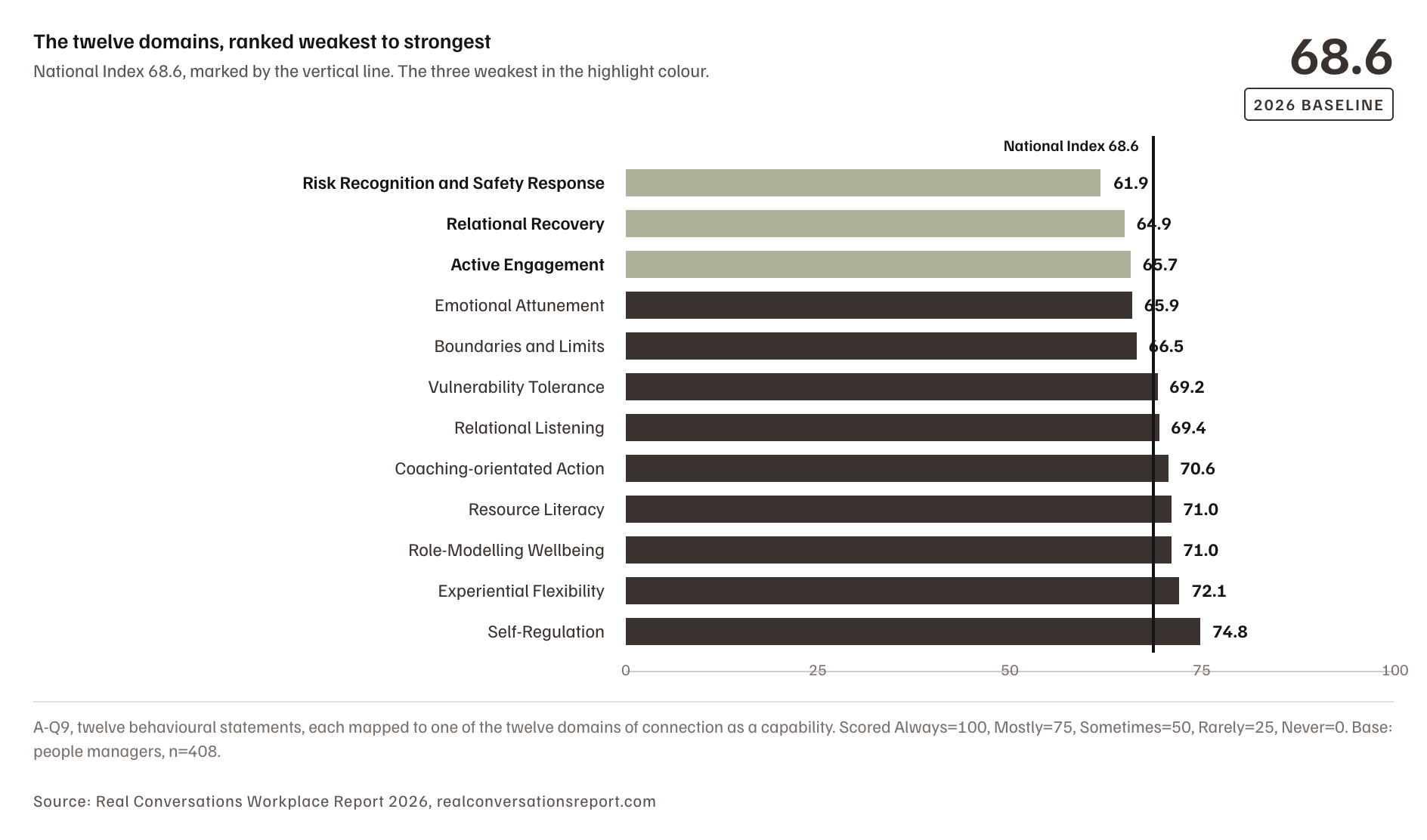
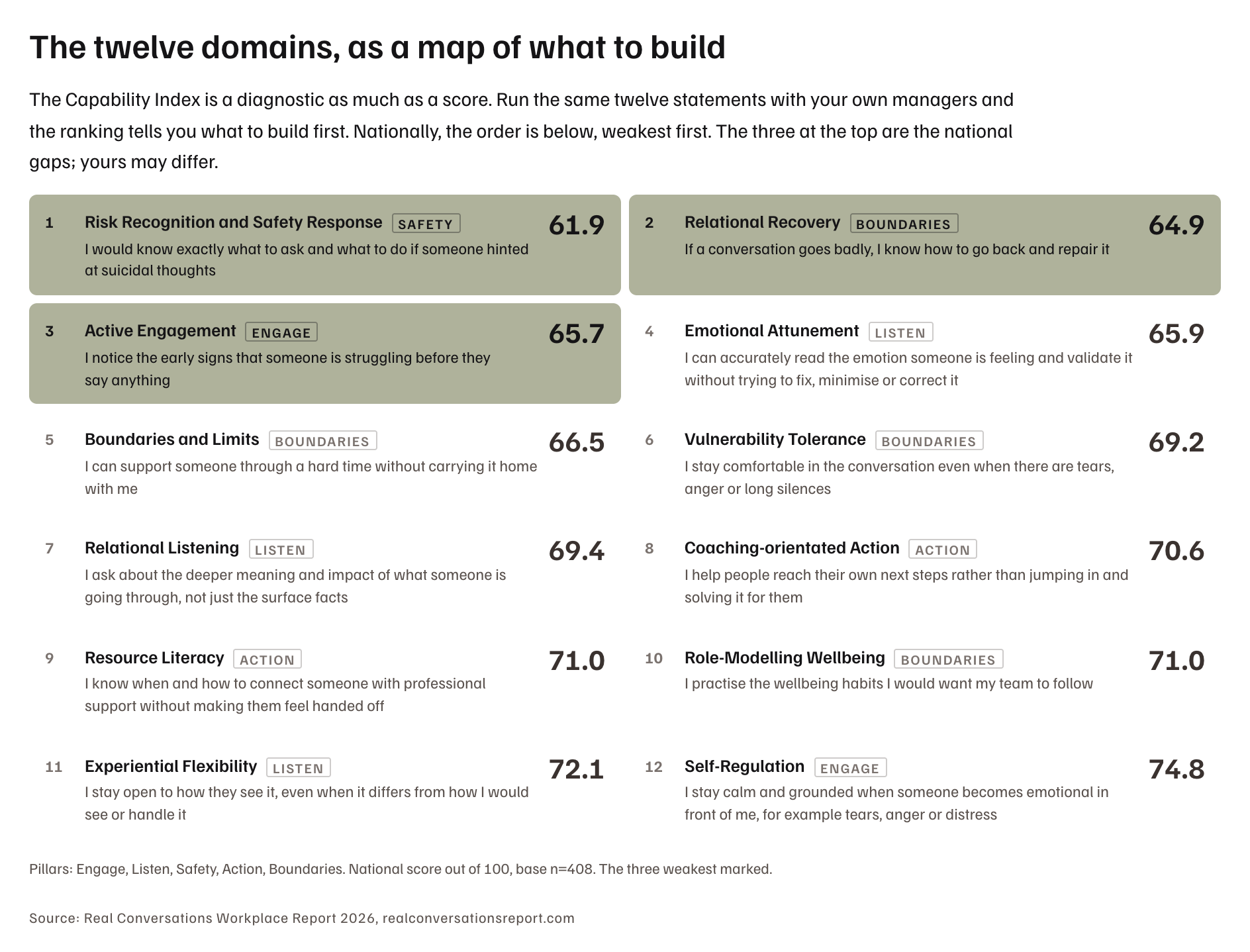
Corporate Australia scores 68.6 out of 100 on connection capability. Managers can stay calm. They cannot reliably notice, attune or repair, and almost one in seven would not know what to ask and what to do if someone hinted at suicidal thoughts.
The twelve domains, ranked weakest to strongest
National Index 68.6, marked by the vertical line. The three weakest in the highlight colour.
68.6
2026 baselineA-Q9, twelve behavioural statements, each mapped to one of the twelve domains of connection as a capability. Scored Always=100, Mostly=75, Sometimes=50, Rarely=25, Never=0. Base: people managers, n=408.
68.6 out of 100
2026 baselineThe Real Conversations Capability Index, year one. Twelve behaviours, self-rated by 408 managers, scored Always 100 to Never 0 and averaged.
Top takeaways
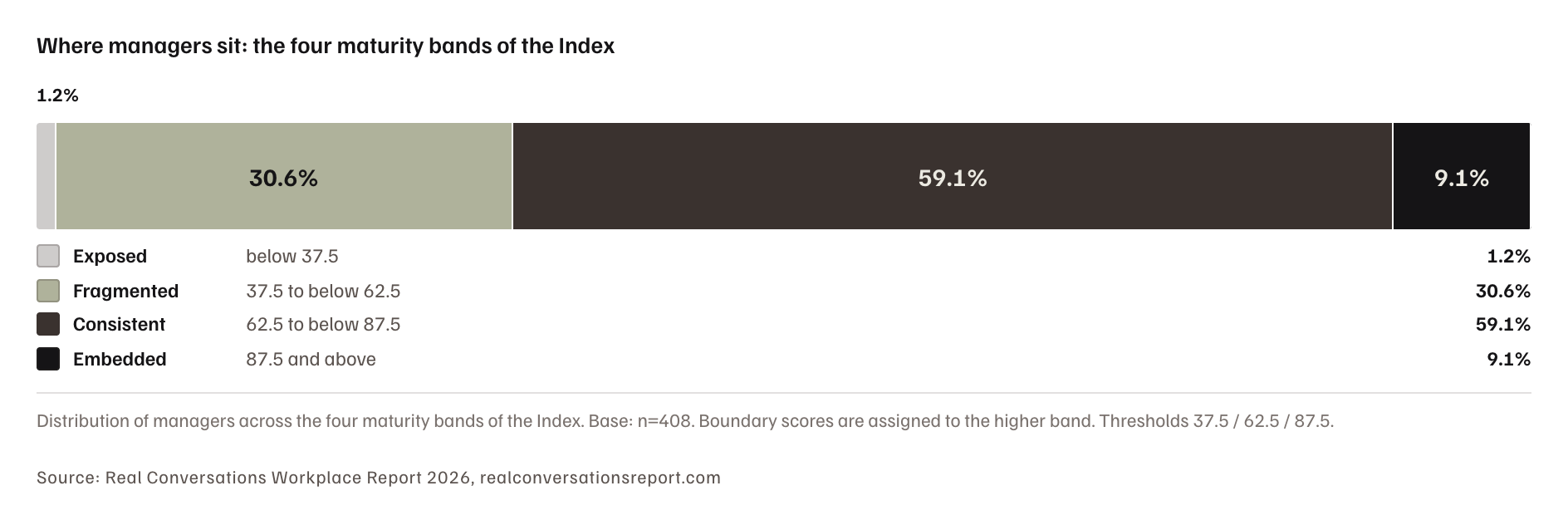
Where managers sit: the four maturity bands of the Index
Distribution of managers across the four maturity bands of the Index. Base: n=408. Boundary scores are assigned to the higher band. Thresholds 37.5 / 62.5 / 87.5.
Strongest
staying calm and grounded when someone becomes emotional in front of them
Weakest
knowing exactly what to ask and what to do if someone hinted at suicidal thoughts
Risk Recognition and Safety Response
61.9The statement: I would know exactly what to ask and what to do if someone hinted at suicidal thoughts.
14.0%
rarely or never true of them
50.0%
true only sometimes at best
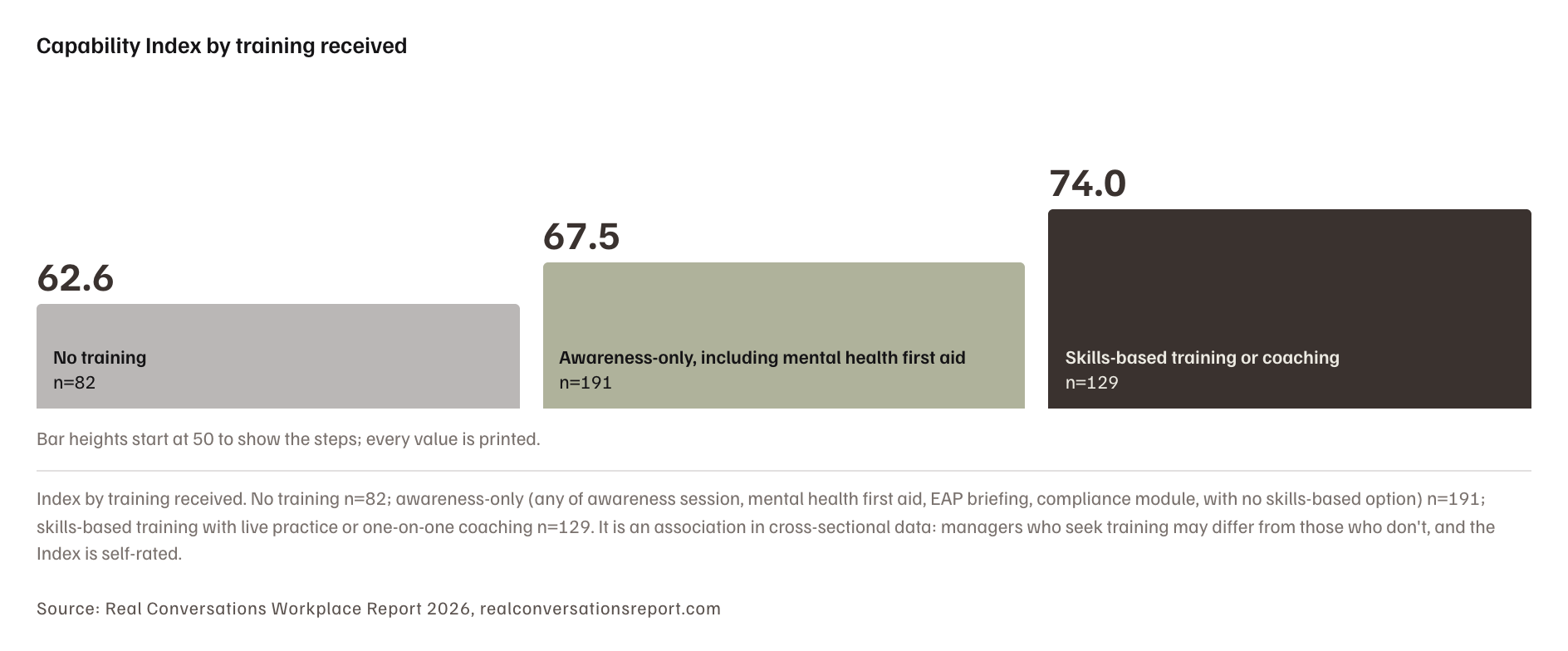
Capability Index by training received
62.6
No training
n=82
67.5
Awareness-only, including mental health first aid
n=191
74.0
Skills-based training or coaching
n=129
Bar heights start at 50 to show the steps; every value is printed.
Index by training received. No training n=82; awareness-only (any of awareness session, mental health first aid, EAP briefing, compliance module, with no skills-based option) n=191; skills-based training with live practice or one-on-one coaching n=129. It is an association in cross-sectional data: managers who seek training may differ from those who don't, and the Index is self-rated.
Supply
31.6%
have had skills-based training or coaching; fewer than one in three
20.1% have had nothing at all
Where they learned it
52.5%
their own personal life experience
formal training 38.0%; trial and error on the job 23.0%
Demand
72.3%
say practical, skills-based training would be valuable in their role
32.4% extremely so
Base: people managers, n=408. A-Q18, A-Q19, A-Q21.
“When one of the team members comes to you and says: I don't know what is happening to me.”
What this means
For executives. 68.6 out of 100 is your industry's baseline. Next year it will be a trend. The organisations that move it will be the ones that trained the noticing, the attuning and the repair, not the ones that ran another awareness session.
If anything here raises something for you, Lifeline is available 24 hours a day on 13 11 14, and Beyond Blue on 1300 22 4636.
What closes the gap
The gap is a skill gap. Skills can be taught, and now they can be measured.
Every finding in this report points at the same layer of the organisation and the same missing capability. Not awareness: Australian managers know the script, 65.0% of them name listening as their first move and 54.9% know that being understood is what helps. Not intent: 64.7% say the conversation is theirs. Not demand: 72.3% want to be taught. What is missing is the skill that turns a calm, well-meant conversation into one where the other person feels understood, and the honest measurement of whether that is happening.
For executives and boards
56.5%
of the workforce not confident their manager could handle the conversation
$3,600 to $4,900
per people manager per year, turnover and claims alone
Treat the Connection Gap as a risk measure and put it beside engagement and safety. More than half your workforce (56.5%) is not confident their manager could handle the conversations that managing psychosocial hazards, a legal duty in every state and territory, now depends on, and almost one in five of the managers carrying that duty cannot describe it. The cost is not hypothetical: $3,600 to $4,900 per people manager per year in turnover and claims alone, on a conservative construction of the data. Multiply by your manager headcount. Then ask what you spend teaching those managers to have the conversation.
For people and L&D leaders
61.4%
of confident managers have never had skills-based training
44.6% vs 25.3%
executives skills-trained against first-line managers
Three moves follow directly from the data. First, change the gate: self-assessed confidence is the wrong criterion for who gets trained, because 61.4% of confident managers have never had skills-based training and confidence is not what tells you who needs it. Assess capability against the twelve domains instead. Second, change the layer: 44.6% of executives are skills-trained against 25.3% of first-line managers, and the first-line managers, by headcount, receive most of the disclosures. Every dollar moved down the org chart reaches more of the people having these conversations than the dollar above it, and young first-line managers are among the most exposed cohorts in the study. Third, change the measure: stop measuring whether managers know what to do and start measuring whether their people feel understood, whether they disclosed what they were going through, and whether anyone asked. Those three numbers sit upstream of everything this report costs.
For managers
The three that make listening land
Active Engagement: noticing
Emotional Attunement: reading and saying it back
Relational Recovery: going back to repair
You probably do listen first. The harder question is what happens next. Three of the four domains where Australian managers rate themselves lowest are the ones that decide whether listening lands: noticing that someone is struggling before they say so, reading what they feel and saying it back without fixing or minimising it, and going back to repair when a conversation went wrong. All three can be taught. The weakest domain of all is the safety response: knowing exactly what to ask and what to do when someone may be at risk. It needs its own training, and Finding 8 shows where it sits. Staying calm, which you already do well, is the foundation they sit on. And if you are one of the 27.2% who sometimes doesn't ask because you are not sure you could handle the answer, the fear is the thing to train, not the question.
The twelve domains, as a map of what to build
The Capability Index is a diagnostic as much as a score. Run the same twelve statements with your own managers and the ranking tells you what to build first. Nationally, the order is below, weakest first. The three at the top are the national gaps; yours may differ.
Risk Recognition and Safety Response SAFETY
I would know exactly what to ask and what to do if someone hinted at suicidal thoughts
Relational Recovery BOUNDARIES
If a conversation goes badly, I know how to go back and repair it
Active Engagement ENGAGE
I notice the early signs that someone is struggling before they say anything
Emotional Attunement LISTEN
I can accurately read the emotion someone is feeling and validate it without trying to fix, minimise or correct it
Boundaries and Limits BOUNDARIES
I can support someone through a hard time without carrying it home with me
Vulnerability Tolerance BOUNDARIES
I stay comfortable in the conversation even when there are tears, anger or long silences
Relational Listening LISTEN
I ask about the deeper meaning and impact of what someone is going through, not just the surface facts
Coaching-orientated Action ACTION
I help people reach their own next steps rather than jumping in and solving it for them
Resource Literacy ACTION
I know when and how to connect someone with professional support without making them feel handed off
Role-Modelling Wellbeing BOUNDARIES
I practise the wellbeing habits I would want my team to follow
Experiential Flexibility LISTEN
I stay open to how they see it, even when it differs from how I would see or handle it
Self-Regulation ENGAGE
I stay calm and grounded when someone becomes emotional in front of me, for example tears, anger or distress
Pillars: Engage, Listen, Safety, Action, Boundaries. National score out of 100, base n=408. The three weakest marked.
Test your own team
The Leadership Connection Gap Scorecard applies the same twelve domains and the same four maturity bands to an individual team or organisation, so a leadership group can read the national number in this report and then find its own. Real Conversations training builds the twelve domains through live practice, which is the format this data associates with the largest lift in capability. Both are available through mitchwallis.com.
If anything here raises something for you, Lifeline is available 24 hours a day on 13 11 14, and Beyond Blue on 1300 22 4636.
How we measured
Two samples, one conversation, and the rules we held ourselves to
Study design
One programmed survey, a router at the screener, two national samples, the same questions from both sides.
Precision
Margins of error at the 95% confidence level.
Who we asked
Two national samples of Australians employed in private-sector organisations with 50 or more employees, surveyed in one programmed questionnaire with a router at the screener. Sample A: 408 people managers with at least one direct report. Sample B: 306 employees with no direct reports who interact with their manager at least monthly. Fieldwork was conducted by Pureprofile, an ISO 20252 accredited research panel with 650,000+ registered Australian members, between 21 August and 4 September 2026. Quotas were set on organisation size, seniority, gender, age and state for Sample A, and soft quotas on gender, age and state for Sample B; the achieved samples are in Section 2, module A. The two samples are independent: no employee in this study reports to a manager in it. Every comparison in this report is between two national groups, never between a manager and their own team.
Mirrored questions
Wherever leaders and employees are shown side by side as a mirrored pair, both sides answered on identical anchors; where the wording or the base differs, the page says so. The employee confidence question carried one additional option, which is kept in the base throughout. Those pages show two numbers side by side: Leaders and Employees. They are never blended, except for the opening question, which is reported on both samples combined and says so.
Precision
At the 95% confidence level, the margin of error is approximately ±4.9 percentage points for the people-manager sample and ±5.6 for the employee sample; the margin on the Connection Gap itself is ±7.1. Segment results carry wider margins and are marked: bases of 60 or more are reported; 30 to 59 are labelled indicative; below 30 are not shown. This is a national positioning study, not a census.
Pre-registration
The primary measure (The Connection Gap), its calculation rule, the treatment of the employee 'would not go to my manager' option, the opening definition question and the named cross-tabs were written down and dated before fieldwork began. That document is summarised in the methodology. Findings outside the pre-registered set are labelled exploratory.
Numbers
Percentages are shown to one decimal place. Columns may not sum to exactly 100% because of rounding. Ratios in the text are never rounded in the direction that overstates. Every statistic carries its base. Where a question was asked only of a subgroup (for example, employees who had been through something significant), the base is named on the page.
What this report measures
This report measures three things that, to our knowledge, no published national Australian workplace study has measured in the form described here before.
1. Whether the conversation lands. Australia has measured how many workers are struggling, how safe they feel to speak up and, most recently, how employees describe a manager's reaction after disclosing a mental health condition. What we found no national Australian study had measured was whether the person who opened up, about anything personal or emotional, felt really listened to and understood, set against a fixed list of what employees report their manager did.
2. Both perspectives on the same conversation, on a mirrored scale. Australia has surveyed workers, it has surveyed leaders, and it has found gaps between what managers believe about themselves and what employees see. What we found no national Australian study had done was ask managers how confident they are that they could have a defined real conversation with someone on their team, and ask employees how confident they are that their own manager could have that same conversation with them, in mirrored wording on common anchors, so the distance between the two answers can be calculated directly and tracked. The samples are separate: no manager here was rated by their own team. That distance is the Connection Gap.
3. An index of the manager's own conversation capability. Australia already has a national workplace index, and a good one. SuperFriend's Indicators of a Thriving Workplace has run for eleven years and scores the Australian workplace out of 100 across five peer-reviewed domains, including connectedness, leadership and capability. Those domains are built from workers rating conditions in their workplace, and Australian researchers have scored managers' self-reported confidence and behaviour in supporting mental health before. What we found no national Australian study had done was turn managers' self-ratings across a fixed battery of twelve discrete conversation behaviours into a single national capability index, calculated by a rule fixed in advance.
"First" means that, in our review of publicly available Australian workplace research and reporting to 7 September 2026, we identified no earlier study drawn across Australian employers, rather than from one employer, sector or state, that met the design described. Non-public internal or proprietary research is outside that review.
The Connection Gap, as calculated
Leaders
68.6%
very or fairly confident (A-Q5)
Employees
43.5%
very or fairly confident about their manager (B-Q9)
The Connection Gap
25.2 points
2026 baselineThe employee option 'I would not go to my manager with something personal, because I don't trust how they would handle it' stays in the denominator as a substantive expression of low confidence. Excluding it: 17.3 points. Computed before rounding.
Index scoring ruler
Boundary scores are assigned to the higher band.
The full methodology is on pages 98 to 101 of the report, the definitions and cost assumptions on pages 102 to 105, and every question as fielded on pages 106 to 111.
How to cite
How to cite this report
How to cite this report
Wallis, M. (2026). Real Conversations Workplace Report 2026: The State of Connection in Corporate Australia. Mitch Wallis Consulting.
Any reference to a statistic from this report, in whole or in part, should name the report and link to the original document in its entirety at realconversationsreport.com. Quotations and charts may be reproduced with attribution and without alteration.
Usage standards
Real Conversations® is a registered trade mark, and the Real Conversations Capability Index is a trade mark, of The Wise Grasshopper Enterprises Pty Ltd, trading as Mitch Wallis Consulting. The Connection Gap, as defined in this report, is a named measure of this study and may be cited with attribution. The questionnaire is published so that the measures can be understood and scrutinised; it may not be fielded, reproduced as a survey or adapted into a scorecard without written permission.
About
Mitch Wallis and Real Conversations

Mitch Wallis is a psychology thought leader, keynote speaker, trainer and author. He holds a Masters in Psychology from Columbia University, spent more than seven years at Microsoft in global roles, founded the national mental health movement Heart On My Sleeve, and has delivered Real Conversations to more than 10,000 people across 200+ organisations on four continents, including Microsoft, Allianz, KPMG, Johnson & Johnson, Lendlease and American Express. His 2024 book, Real Conversations, was an Australian Business Book Awards finalist, and he advises the United Nations on youth mental health. He lives with OCD, anxiety and depression, and his own experience of complex mental illness, and of being on both sides of the conversations this report describes, is where the work began.
Real Conversations teaches people how to handle the hardest and most important human conversations with calm and clarity. It is built around twelve domains of connection as a capability, taught through the five conversation characters and live experiential practice, and delivered as keynotes, workshops, a six-week intensive, and an online academy. The Leadership Connection Gap Scorecard applies the same twelve domains and maturity bands used in this report to an individual leadership team.
Acknowledgements
Fieldwork, programming, panel management and data delivery: Pureprofile. Operations and project management: Mel Taylor. Research design, analysis and writing: Mitch Wallis with analytical support. Thanks above all to the 714 Australians who answered honestly.
Contact
Media, speaking and partnership enquiries: contact@mitchwallis.com. Real Conversations training and the Leadership Connection Gap Scorecard: mitchwallis.com.
Real Conversations Workplace Report 2026
The State of Connection in Corporate Australia
Managers confident they could have a real conversation with a struggling team member: 68.6%. Employees confident their manager could: 43.5%. The Connection Gap: 25.2 points, computed before rounding. Leaders: A-Q5, n=408. Employees: B-Q9, n=306, full base including the 'would not go to my manager' option.
Download the report
The full report runs to 114 pages and prints every question and every rule the numbers rest on.
Test your own team
The Leadership Connection Gap Scorecard applies the same twelve domains and maturity bands used in this report to an individual leadership team.
Test your own teamReal Conversations Workplace Report 2026
Done. The report is ready to open below, and a copy is on its way to {{ submittedEmail }}.
While you're here: the Leadership Connection Gap Scorecard applies the same twelve domains and the same four maturity bands used in the report to your own leadership team.
Test your own teamIf anything in this report has raised something for you, Lifeline is available 24 hours a day on 13 11 14, and Beyond Blue on 1300 22 4636. In an emergency, call 000.